| Subject | Science |
| Week Theme | Journeys & Heirlooms |
| Lesson | Science · Week 2 · Lesson 1 |
| Time | 30–45 minutes |
| Grade Level | 2nd Grade (adaptable for Grades 1–4) |
| Mentor Text | The Ugly Vegetables by Grace Lin |
| Materials |
|
Students will explain why families might bring seeds to a new country and identify what plants need to grow (sunlight, water, soil, climate).
This first science lesson starts with a story. In The Ugly Vegetables, a girl's mother grows Chinese vegetables in their American garden for the soup her family loves. The plants are part of who the family is. The plant investigation that starts next week follows the same idea: people moved and brought what mattered to them, and some things grew well in the new place while others struggled. Today students name what plants need (sunlight, water, soil, climate) and connect it to why families carried seeds across an ocean.
💡 Teacher Note: Read slowly and don't rush to the chart. When the neighbors smell the soup, wonder aloud: “I wonder why her mom grows these vegetables instead of the flowers the neighbors grow…”
How can we honor every family's story and show how those stories make America ours?
The Ugly Vegetables shows students how a family's seeds and garden carry their culture into a new home.
Read The Ugly Vegetables by Grace Lin aloud before today if you can; a first read adds a few minutes.
- Title a piece of chart paper Plants Thrive When… and leave the rest blank.
- Have the seed packets visible (basil, dill, cilantro, mint, or any combination). Don't open them; students plant next week.
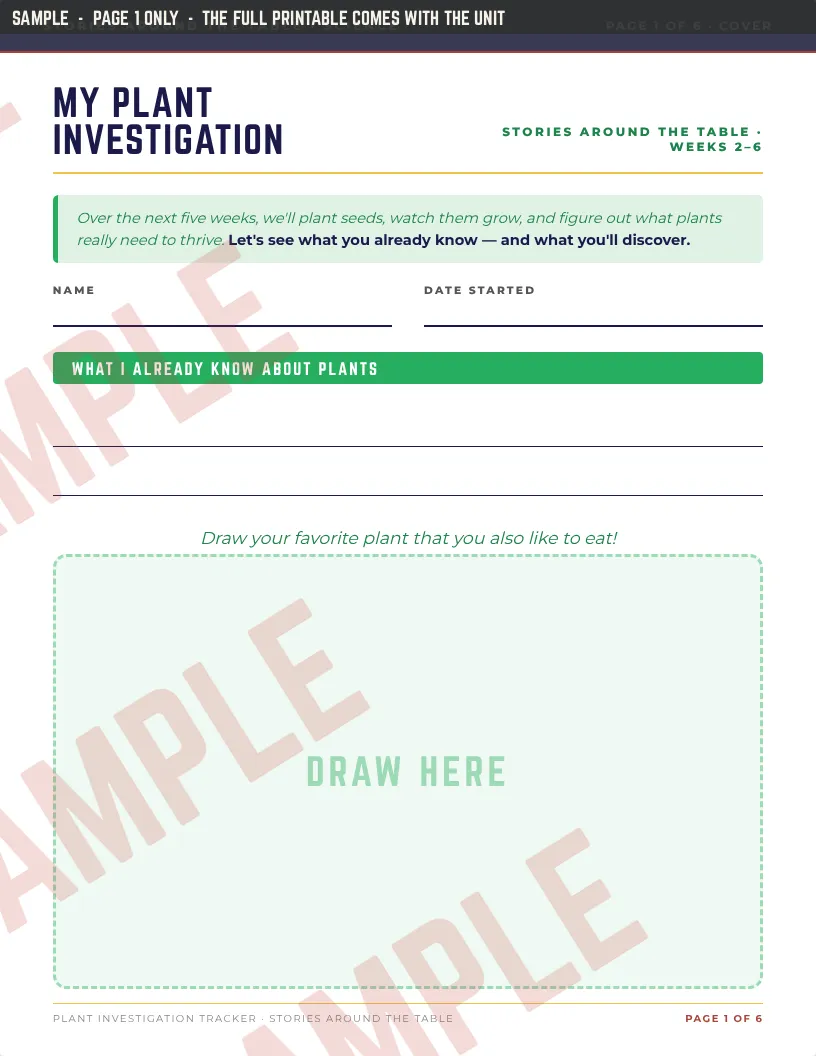
- Make sure each student has their Plant Investigation Tracker (printed at the start of Week 2 and used through Week 6) and something to draw with.
1Mini Lesson~5–10 minutes
Gather students and hold up The Ugly Vegetables.
We've read this book together. Today we'll think about it as scientists. Inside this story is a question scientists ask all the time: what do living things need to survive?
Hold up the seed packets.
These are real seeds: basil, dill, cilantro, mint. Families have carried seeds like these for hundreds of years when they moved to new countries. Why would somebody pack seeds in a suitcase?
Take 2–3 responses. Accept them without explaining yet. Look for answers such as “to remember home,” “to grow the food they like,” or “because they couldn't buy those plants in the new place.”
If we want to grow these in our classroom, we need to know what plants need.
2Building the Anchor Chart~5–10 minutes
Reread one or two pages: the mom tending the garden, or the soup being shared. Think aloud:
I notice the mom waters these plants every day. I think water might be one thing plants need.
I notice the garden is in the front yard, in the sun. I bet sunlight matters.
Add water and sunlight to the chart. Then ask:
What else does a plant need? Look at the pictures. Think about plants you've seen growing.
Draw out soil and climate (the right kind of weather). If no one says climate, ask: “These plants are growing in summer. Could they grow outside in a snowstorm? Why not?” By the end, the chart should read:
- Plants Thrive When…
- They have water
- They have sunlight
- They have good soil
- They are in the right climate
3Independent Practice~10–15 minutes
Students open their Plant Investigation Tracker to Page 2 (Week 2: What Plants Need).
In the big sketch box, draw a plant and label what it needs to thrive. Use our chart, and add anything else you think is true.
Circulate and note who needed the chart. Listen for misconceptions (“plants eat with their mouths”) and partial ideas (“they need rain”) to build on next week. Don't correct today; just notice.
4Share~5 minutes
Invite 2–3 students to share their drawings and what they labeled. Name specific choices: “She drew the sun on her plant. That's what a scientist does.” Write this sentence stem on chart paper:
Plants need ______ to thrive.
Students write it under their drawing on Page 2 of their tracker. Leave room for students who write more than one need.
In Week 3, students plant seeds, write growth predictions, and learn the word variable as the class investigation begins.
| Reading | The Ugly Vegetables has a clear arc that students can retell on five fingers, like this week's Reading mentor texts. |
| Writing | Many family stories live in food and in what families brought with them, the same ground as Grace Lin's narrator. |
| Social Studies | The food and plants immigrants brought through Ellis Island became part of American culture, which connects the seed packets to the We Speak Like Experts chart. |
- NGSS · 2-LS2-1 — Plan and conduct an investigation to determine if plants need sunlight and water to grow.Lesson connection: Students name what plants need to grow and draw a labeled plant to get ready for the class investigation.
© 2026 The Integrated Learning Studio · Licensed for single classroom use only.